How UPS Airlines Built a Leadership Pipeline That Actually Works
Private Training / Case Study
How UPS Airlines Built a Leadership Pipeline That Actually Works
what happens when a company stops treating leadership development as a checkbox and starts treating it as a competitive strategy.
The Leadership Gap Is Costing Companies More Than They Think
Sixty percent of new managers fail within their first two years on the job. Not because they lack technical skill. Not because they are not hardworking. Because no one taught them how to lead.
Ask leaders what their biggest challenge is right now, and the answers are strikingly consistent. At the 2026 LeadingBetter Summit, nearly 500 leaders from across Louisville’s business community answered that exact question. Forty-two percent named leading through change and uncertainty as their top challenge. Twenty-three percent pointed to clear communication. Sixteen percent cited accountability.
And when asked what leadership skill their organizations most need right now, the word that came back most often was empathy, followed closely by coaching, accountability, and collaboration.
These are not abstract concerns. They are the daily reality of leadership in 2026.
And yet most organizations leave leaders to figure these things out on their own. Some roll out an off-the-shelf training module and call it done. Others do nothing and hope their managers somehow grow into the role.
UPS Airlines chose a third option.
The Challenge: Strong Programs Were Not Enough
UPS is not a company that neglects its people. Robust internal training programs, career development frameworks, and a long-standing commitment to leadership have always been part of the culture. UPS Airlines has also long partnered with the Leadership Louisville Center, supporting leaders through community-based programs that expand perspective and strengthen civic connection.
But for Sharnika Glenn, Vice President of Human Resources for UPS Airlines, something was still missing for the organization’s highest-potential talent.
 “The leader of ten years ago is not necessarily the same kind of leader we need today.”
Sharnika Glenn, Vice President of Human Resources, UPS Airlines
“We wanted to take our leadership development opportunities to the next level, and Leadership Louisville Center came to the table with cutting-edge approaches that met that challenge,” Glenn said.
The logistics industry moves fast. The pace of change inside UPS Airlines, from technology and operations to workforce dynamics and enterprise strategy, means that leaders who were effective five years ago must continuously evolve.
Internal programs can build foundational skills. What they struggle to provide is perspective, the kind that only comes from stepping outside your organization, your function, and your familiar frame of reference.
That is the gap the UPS Leadership Academy was built to close.
The Solution: A Private Cohort Built Around Real Leadership Needs
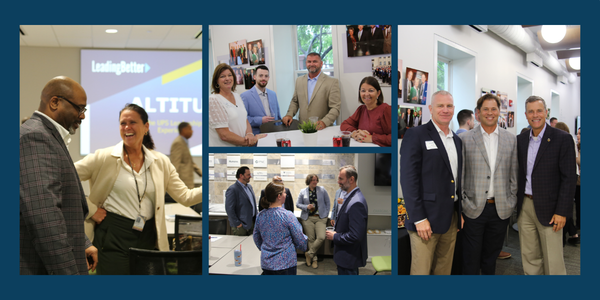
Working with the Leadership Louisville Center and its LeadingBetter partner brand, UPS Airlines designed a customized, six-month Leadership Academy for a select group of high-potential leaders.
This was not an open-enrollment workshop or a two-day retreat. It was a sustained, intentional development experience built specifically for UPS, delivered to leaders who were handpicked for their readiness to take on greater responsibility.
“This is a program that gives them smaller group sessions and intense access to the LeadingBetter and Leadership Louisville Center team.”
Sharnika Glenn
“They get one-on-one coaching, one-on-one development. And having it over a period of time helps them, as they continue to work, utilize the tools they are learning in class,” Glenn said.
That last point matters. The Academy does not pull leaders out of their roles for weeks at a time. It runs alongside their work, so every concept, framework, and conversation can be applied immediately.
The LeadingBetter Framework
The Academy is structured around three interconnected pillars:
Leading Self
Emotional intelligence, self-awareness, communication styles, personal accountability, and resilience.
Leading Others
Coaching and feedback, building trust, inclusive team leadership, and adaptive management.
Leading the Business
Strategic thinking, driving innovation and change, and leading across functions to achieve enterprise-level results.
Each participant also completes a DISC assessment, giving them a concrete, personalized lens for understanding how they communicate, how they are perceived, and how to adapt both.
Across UPS cohort programs, curriculum has included sessions on executive presence, storytelling for business, courageous communication, delegation, resilience and energy management, inclusive leadership, influencing change, raising the net worth of your network, and peer coaching structures.
But the framework is only part of the story. The Academy is structured as a cohort, a small group of peers from across the organization learning together over six months. In an organization where business moves at the speed of trust, the relationships built inside the cohort are not a side benefit. They are part of the point.
What Participants Actually Experienced
Ask an HR executive what a leadership program delivers and you will hear words like confidence, capability, and engagement. Those are real outcomes. But they do not fully capture what it feels like to be inside the room.
Christopher Harris, a manager at UPS Airlines and a graduate of the Leadership Academy, gave the closing speech at his cohort’s graduation. What he shared captures something no simple outcomes summary can.
“It helped me see how to adjust my approach for each person and situation. I went back to my team seeing how I could change myself to help others succeed.”
Christopher Harris, UPS Airlines Manager and Leadership Academy Graduate
Partway through the six-month cohort, Harris had a compliance issue land on his desk at UPS’s Louisville Worldport facility. He did not have the answer. He needed someone on the flight side of the operation, someone close to the pilot community, and he needed them fast.
Then he remembered he had a cohort peer. Someone he had been paired with from day one. Someone he had spent six months learning alongside.
He reached out. The response came back: “Sorry, who is this? I don’t have this number saved.”
Harris laughed telling the story. But here is the part that matters: that same person, who did not have Harris’s number saved, spent hours working through his own network to track down the answer. He made calls. He came back with what Harris needed.
“That’s what that partnership is. He had no problem taking that time, even though he didn’t save my number, and helping me out. Which ultimately resulted in compliance at Worldport.”
Christopher Harris
A relationship built inside a leadership cohort produced a real, traceable business outcome. That is not a soft skill. That is operational impact.
The Business Impact: What the Organization Gained
The outcomes from the UPS Leadership Academy show up in a few different ways, some measurable, some harder to quantify but just as real.
 “Through these programs, our leaders have been able to build real confidence, and through that they have been able to do that for themselves, for their teams, and for the business.”
Tina Chesher, HRBP Manager, UPS Louisville Worldport
Chesher said the program has helped leaders communicate more clearly with their teams and build stronger cross-functional understanding across the business.
She also spoke to why this kind of development matters right now, in a climate of constant change:
“Leadership isn’t an option. Leadership Louisville gives you that anchor that helps give you the skills you need during this time of uncertainty.”
Tina Chesher
Glenn pointed to the network effect as one of the Academy’s most consistent outcomes.
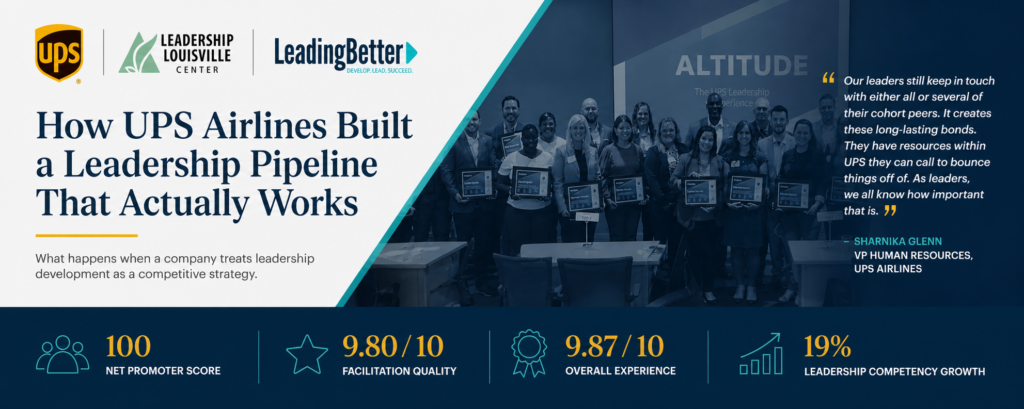
“Our leaders still keep in touch with either all or several of their cohort peers. It creates these long-lasting bonds. They have resources within UPS they can call to bounce things off of. As leaders, we all know how important that is.”
Sharnika Glenn
Outcomes by the Numbers
UPS Airlines has now run multiple cohorts across both ELEVATION and ALTITUDE, with a new ALTITUDE class already enrolled for 2026. That continued investment is a clear signal that the model is working.
Net Promoter Score across 2023 to 2025 cohorts
Average facilitation quality rating for full program year
Overall experience rating across the full program year
Average improvement in self-assessed leadership competency
In one tracked participant group, average self-assessment scores across 25 leadership competencies rose from 7.05 to 8.41 on a 10-point scale. Competencies measured included self-awareness, executive presence, delegation, strategic thinking, resilience, and inclusive leadership.
Documented cohorts to date include participants from 2023-2025 and current 2026 cohort.
The business case for leadership development is not ambiguous.
Structured leadership programs help organizations improve retention, strengthen manager effectiveness, increase productivity, and build stronger internal leadership pipelines. What makes the UPS Leadership Academy notable is that it delivers those returns through a model that is customized, sustained, and deeply relational rather than generic, transactional, and forgotten by the following Monday.
A Partnership Rooted in Purpose
The UPS Leadership Academy did not appear out of nowhere. It is the latest chapter in a partnership between UPS Airlines and the Leadership Louisville Center that stretches back decades.
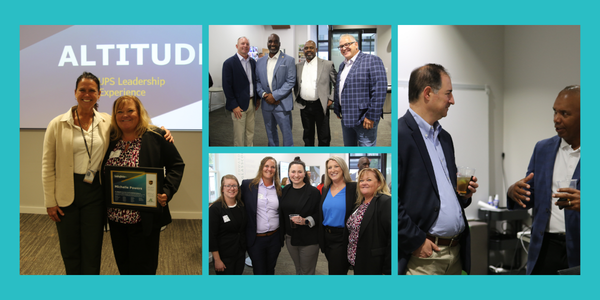
UPS leaders have moved through Leadership Louisville’s flagship programs including Focus Louisville, Leadership Louisville, Bingham Fellows, and Ignite Louisville. The Academy is a natural evolution of that relationship, designed specifically for what UPS needs now.
The custom cohort programs are now multi-year commitments, with ELEVATION and ALTITUDE running consecutive cohorts and a new ALTITUDE class already enrolled for 2026. That continuity is not incidental. It reflects an organizational decision to treat leadership development as an ongoing investment, not a one-time event.
 “Leadership Louisville gives us an opportunity to rub shoulders with the leaders of the city, from civic to charitable, education, workforce creation, and other businesses. It’s an opportunity you generally don’t get in your ordinary business networking environments.”
Michael Francisconi, Chief Counsel and Vice President of Legal, UPS Airlines
Francisconi also spoke to the multiplier effect that comes when organizations send their people through programs like this.
“Getting other future leaders in my organization involved in the programs, they were able to go out as emissaries in the community and do the same thing I did.”
Michael Francisconi
This is a dimension of private leadership development that most vendors never talk about. When your leaders grow, they do not just become better managers inside your walls. They become better citizens, connectors, and contributors to the broader community your business depends on.
“Leadership Louisville keeps us at the forefront of what leadership needs to be. They have their finger on the pulse of the future, helping us shape the leaders who will guide UPS, and Louisville, into what’s next.”
Sharnika Glenn
Is This the Right Investment for Your Organization?
UPS did not build the Leadership Academy because they had budget to spare. They built it because the cost of underdeveloped leaders was higher than the cost of the program.
If your organization is navigating fast change, struggling to build bench strength, or watching talented people plateau because no one has invested in their growth, the Academy model is worth a serious look.
Private Academies
A fully customized, multi-month cohort experience for your high-potential leaders, built around your goals, your culture, and your timeline.
Targeted Private Training
A focused session or series designed to address a specific leadership challenge your team is facing right now.
Open-Enrollment Workshops
Build individual leadership capability across your organization through LeadingBetter’s proven public programming.
Ready to explore a private cohort for your organization?
Let’s talk about what a customized leadership academy could look like for your team, your goals, and your timeline.
Frequently Asked Questions About Private Leadership Training
What is a private leadership cohort?
A private leadership cohort is a customized group-based development program designed exclusively for employees of one organization. Unlike open-enrollment workshops that mix participants from different companies, a private cohort is built around the specific goals, culture, and leadership challenges of the sponsoring organization.
Participants learn alongside colleagues, often from different departments or functions, which strengthens internal relationships alongside individual capability. Programs typically run over several months to allow for real-world application between sessions.
How is private leadership training different from generic leadership programs?
Generic programs teach broadly applicable leadership principles to a mixed audience. Private training goes deeper because the content, examples, and exercises are tailored to the organization’s actual context.
Participants do not have to translate frameworks to their situation. Those frameworks are built around their situation from the start. Private programs also create stronger peer bonds because participants share the same organizational culture, challenges, and goals.
How long does a private leadership cohort typically run?
Most effective private cohort programs run between four and twelve months. The UPS Leadership Academy runs six months, which allows enough time for participants to engage deeply with the material, apply new skills on the job between sessions, and build lasting relationships with cohort peers.
Shorter programs can address specific skills or challenges. Multi-month programs are better suited for broader leadership transformation and building organizational bench strength.
How do you measure the ROI of a leadership development program?
ROI from leadership development shows up in several ways: employee retention, promotion rates, manager effectiveness scores, team engagement, cross-functional collaboration, and business performance outcomes that can be linked to specific leader decisions and behaviors.
In UPS Airlines’ programs, participants showed an average 19% improvement in self-assessed leadership competency scores across 25 dimensions, from self-awareness and executive presence to delegation and strategic thinking. The ELEVATION cohorts also achieved a Net Promoter Score of 100 across 2023 to 2025 survey respondents.
The most effective way to measure ROI is to establish a baseline before the program begins and track specific outcomes over the 12 to 24 months following graduation.
Who should be selected for a private leadership cohort?
The most effective cohorts are selective rather than universal. Organizations typically nominate high-potential employees who have demonstrated strong performance and are ready for greater responsibility.
Selection by direct managers, not self-nomination, tends to produce stronger cohorts because it signals organizational investment and sets clear expectations about the development pathway ahead. Cross-functional diversity within the cohort also matters because participants build broader internal networks and carry those connections back to their work.
What does LeadingBetter’s private training include?
LeadingBetter’s private training engagements are built around the organization’s specific goals and may include facilitated small-group workshops, one-on-one coaching, peer coaching groups, self-assessment tools like DISC, peer learning structures, and access to Leadership Louisville Center’s broader programming and community.
The scope, duration, and focus of each engagement is customized through an initial discovery process with the client’s HR and leadership teams.
How much does private leadership training cost?
Private leadership training investment varies based on cohort size, program length, and the level of customization involved. Every LeadingBetter private engagement begins with a discovery conversation to understand your goals, your people, and the outcomes you are trying to achieve before any scope or investment is proposed.
To discuss what a program might look like for your organization, contact our team.
About LeadingBetter
LeadingBetter is the private training partner brand of the Leadership Louisville Center. For decades, Leadership Louisville has developed leaders who strengthen organizations and communities across the region. LeadingBetter brings that same expertise to organizations looking to build their own leadership capacity through customized academies, private trainings, and open-enrollment programming.
